Transcriptomic Profiling of Type 2 Diabetes — Riyadh Cohort
Whole-blood RNA sequencing of 120 participants (60 T2DM / 60 controls) from a Riyadh tertiary hospital. Identified 847 differentially expressed genes, enriched inflammatory pathways, and three hub-gene biomarker candidates for early T2DM detection in an Arabian-population cohort.
Project highlights
Quick summary
When you want reproducible differentially expressed genes and a biological pathway from RNA-seq data, plus a diagnostic model validated outside the discovery cohort.
We built a full RNA-seq pipeline and trained a validated diagnostic classifier.
- Reproducible RNA-seq analysis pipeline with version-controlled code.
- Differential-expression and pathway-enrichment report with publication-quality figures.
Methods & Tools
Discovering a reproducible transcriptomic signature for type 2 diabetes required rigorous control of false discovery across thousands of genes and a diagnostic model that generalized beyond the discovery cohort.
Processed RNA-seq reads (QC, STAR/Salmon alignment and quantification) for 120 participants and normalized counts with robust library-size and dispersion estimation.
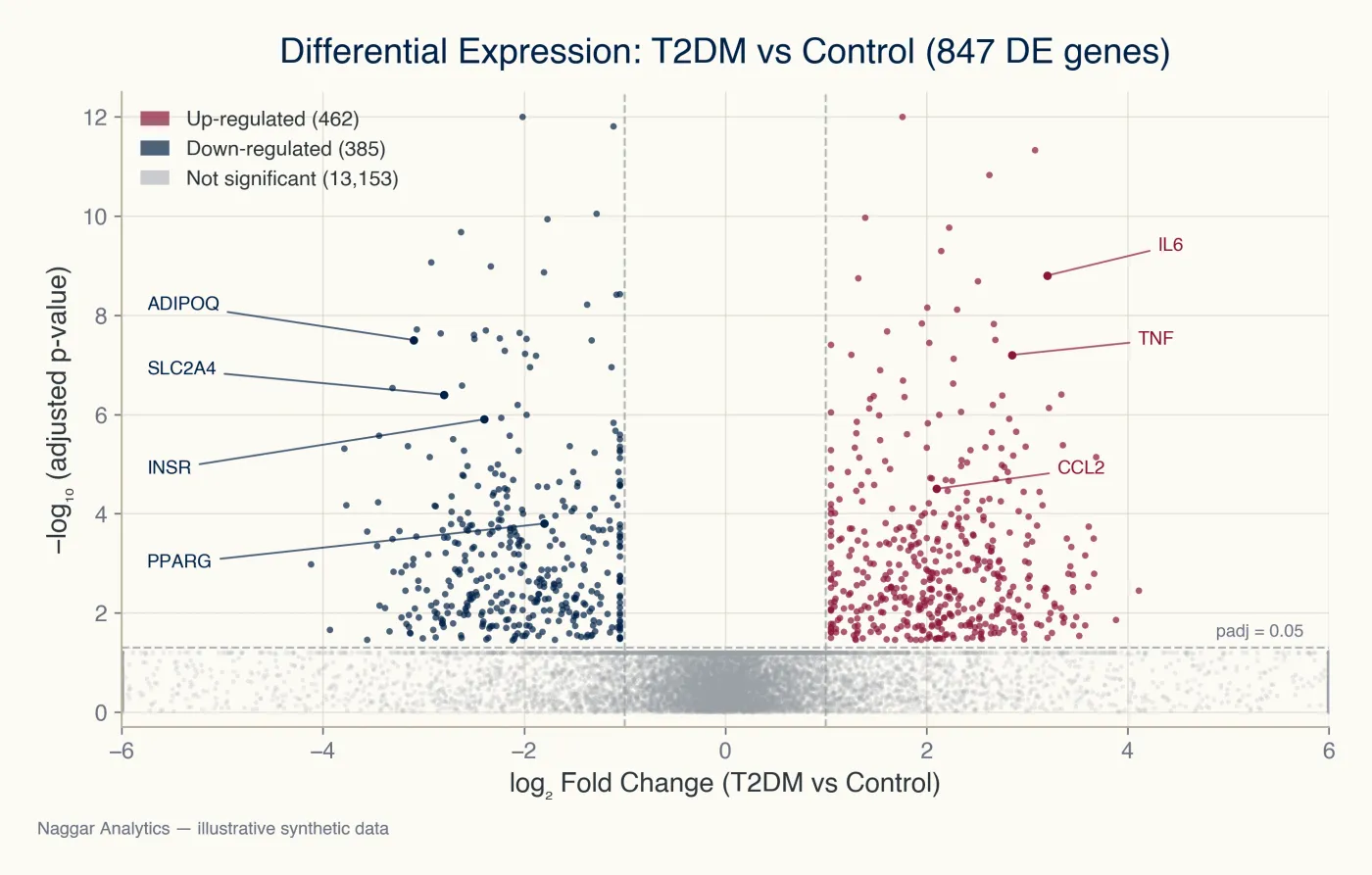
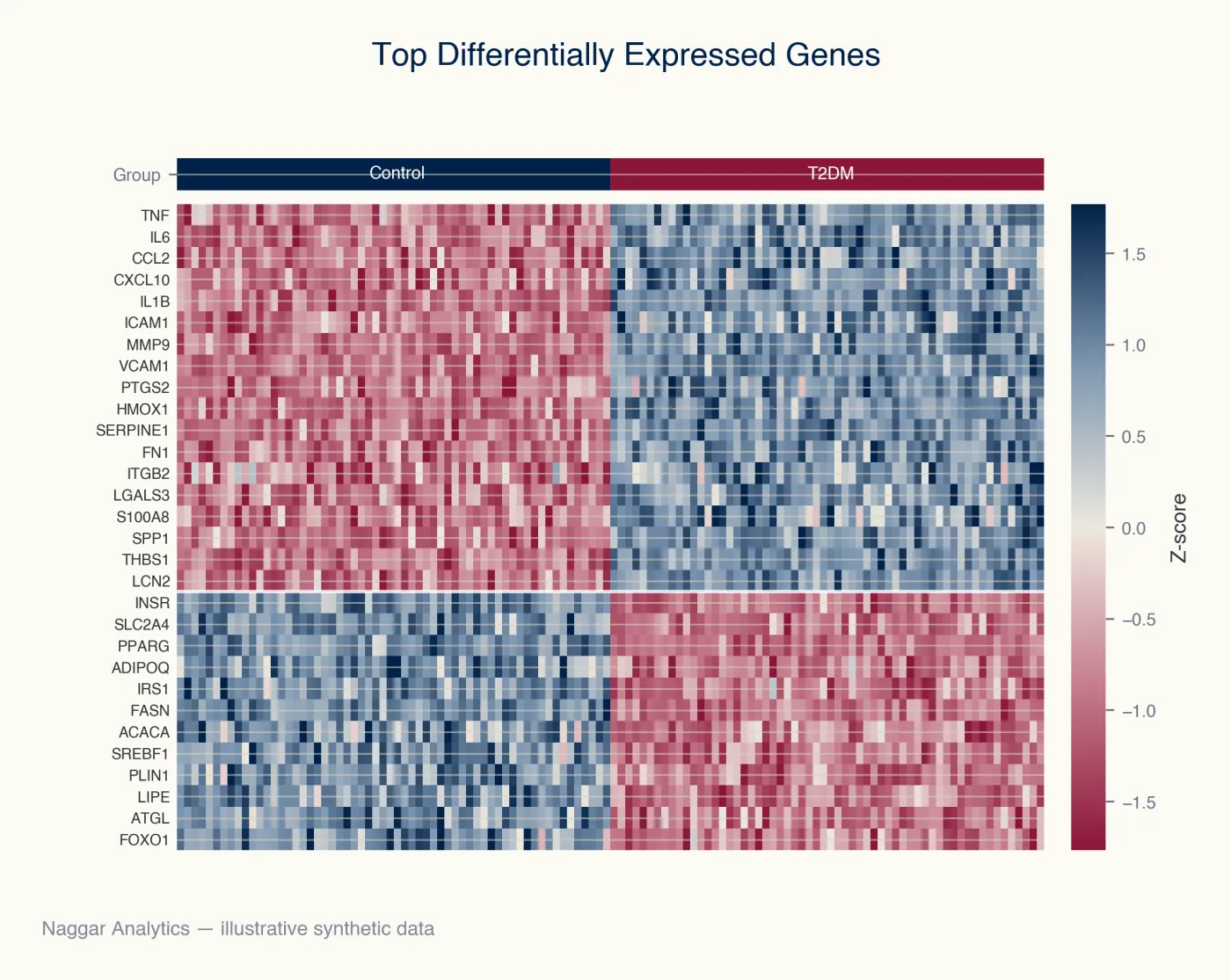
Identified 847 differentially expressed genes with DESeq2/edgeR under Benjamini–Hochberg FDR control, and interpreted them via GSEA and clusterProfiler pathway enrichment.
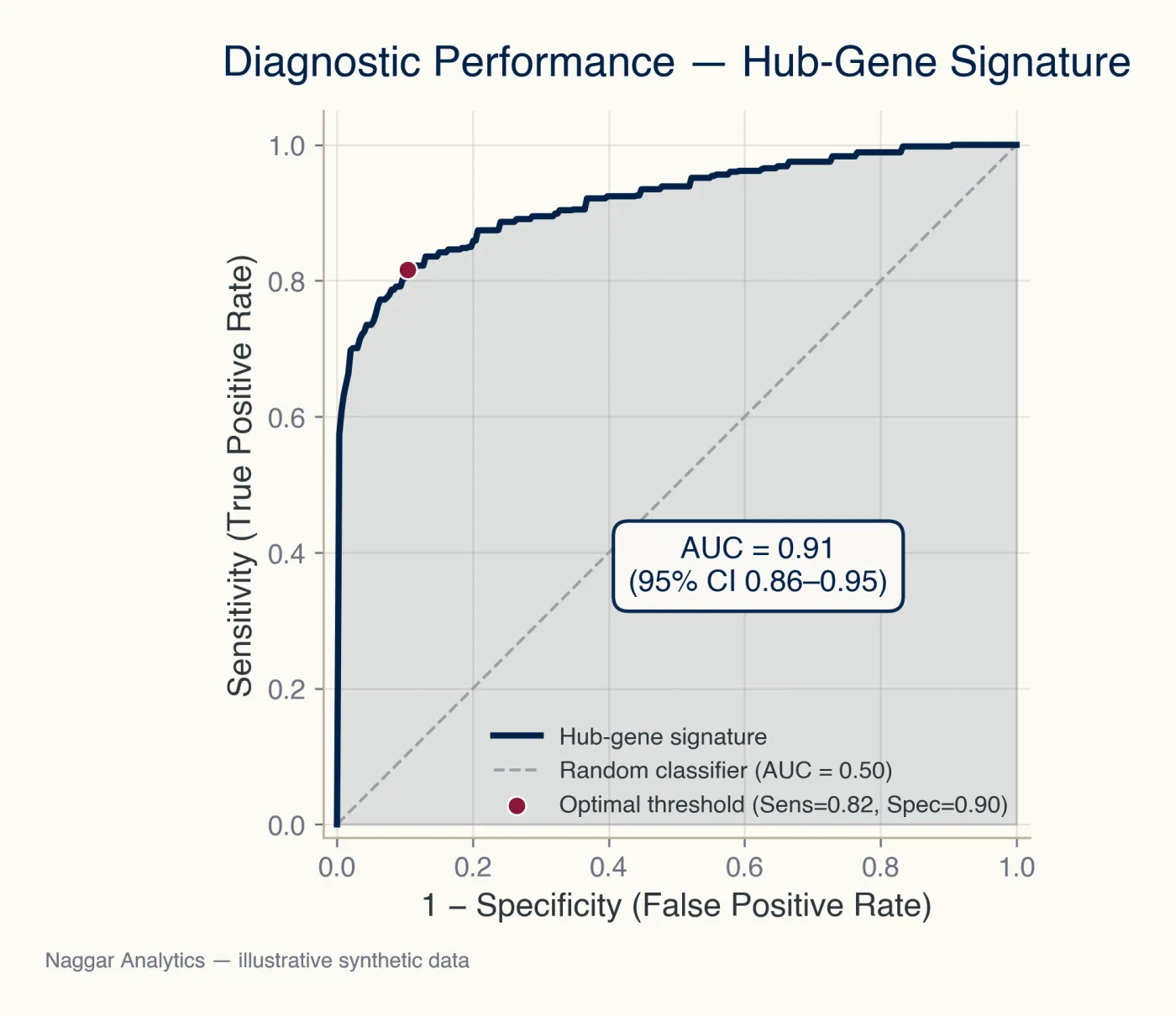
Trained a regularized diagnostic classifier with nested cross-validation (AUC 0.91) and visualized co-expression networks in Cytoscape.
Reproducible RNA-seq analysis pipeline with version-controlled code.
Differential-expression and pathway-enrichment report with publication-quality figures.
Cross-validated diagnostic signature with performance and calibration metrics.
False discovery controlled with Benjamini–Hochberg across all genes tested.
Diagnostic classifier evaluated with nested cross-validation to avoid optimism bias.
Batch effects diagnosed and adjusted before differential-expression testing.
End-to-end pipeline version-controlled and fully reproducible.
The bioinformatics part was what worried me most — the sequencing data was big and not clean. They processed it, ran the full pipeline, and explained the results in a way I could actually put into my paper. And there were no long revisions after, which I appreciated.
Have a project to register?
Submit your project in the dashboard and we’ll map the analysis plan, deliverables, and timeline.